What is a flute?
The flute is a family of musical instruments in the woodwind group. Most woodwind instruments, like saxophones and clarinets, use reeds to produce sounds. However, a flute is an aerophone or reedless wind instrument that produces its sound from the flow of air across an opening.

History of the flute
The flute is one of oldest instruments in the world, newer only than the drum. The original flutes were made of bone or hollowed sticks. Ancient people cut holes in to add pitch variation. The modern flute we know today was developed by Theobald Boehm in the 1800s. We still use his name when referring to the Boehm fingering system.
For a long time, the main body of the flute was still made of wood (hence why it’s part of the woodwind family), which was quite fatiguing to play. It was not until the end of the 19th century that the metal flute was perfected.
What key are flutes played in?
Flutes are a non-transposing instrument. The most common concert flutes are played in the key of C Major and at concert pitch (C on the piano).
What is a flute player called?
A musician who plays the flute can be referred to as a flute player, flautist, flutist or, less commonly, fluter or flutenist.
Parts of the flute
Headjoint
The headjoint is the top part of all flutes. It's the piece that flute players blow into to create the sound. Often made of solid silver, the material used impacts the sound greatly, deciding the overall character of the tone. The headjoint features the tuning cork which is used to further adjust the intonation of the flute.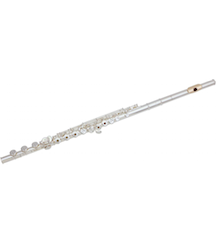
Body
Containing most keys, the center piece, or body, is the biggest part of every flute.
Footjoint
Containing several keys, the footjoint is the shortest part of the flute. The standard student foot is a C foot, while you'll find a B foot on most intermediate and professional models.
Flute Categories
Student Flutes
Crafted specifically with first-time players in mind, student flutes are constructed to help guide students while endorsing good playing practices. Usually these flutes feature a nickel construction with silver-plated plateau keys, as well as an offset G and a C footjoint. Some teachers will even request an open-hole flute or a flute with the split-E design.
Check out these student flutes:
Etude Model EFL-100 Student Flute
Gemeinhardt 2SP Series Student Flute
Intermediate Flutes
When a flautist is ready to move up to the next level, they typically upgrade to intermediate flutes which are crafted to help advance their skills even further. Often referred to as "performance," "step-up," or "conservatory" flutes, these instruments usually have a solid silver headjoint and either a solid silver or silver-plated body and footjoint. Also, intermediate flutes frequently have a B footjoint, as well as open-hole keys with "inline" G keys, although "offset" G keys are becoming more popular.
Take a look at these intermediate flutes:
Yamaha YFL-362 Intermediate Flute
Pearl Flutes 525 Series Intermediate Flute
Professional Flutes
Designed and constructed with professional musicians in mind, professional flutes are high-end instruments made with fine materials and detailed craftsmanship. Generally, professional flutes are crafted with open holes and solid (sterling) silver head, body, and foot joints. Many professional flutes are handmade to very tight tolerances for maximum performance.
Yamaha Professional 797H Series Flute
Di Zhao DZ 600 Professional Flute Offset G B-Foot
Artisan Flutes
Handcrafted, these flutes are unlike any other as they are left completely to the imagination of the artists that make them. Most are still silver-plated over solid silver, but you'll also find gold or rose gold-plating and they often feature additional engraving on the embouchure plate and keys.
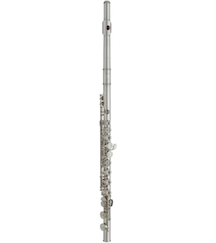 What are flutes made of?
 What are flutes made of?
As mentioned above, early flutes were made of bone or sticks. As they developed, they continued to be made of wood. Metal flutes weren’t perfected until the end of the 19th century.
Nickel Silver
Extremely durable and used because it resists dents, a nickel silver flute produces a beautiful tone, making it perfect for the beginner flute player. Usually paired with silver-plating, nickel silver is even used on some intermediate flute keys, giving them a sturdier construction without extra weight.
Solid (Sterling) Silver
With a warm, dark, focused tone and a clean response, solid silver is heavier than nickel silver, making it the preferred choice for intermediate and professional flute players. One thing to note, solid silver also requires greater handling to prevent tarnishing and to keep it in top playing condition, so it's not suited for novice players that may not be as careful.
Plating Materials
Nickel
Mostly found on student flutes, nickel is extremely durable and is easy to look after. And because it's lighter in weight than most other materials, it produces a much brighter sound. It's also a great alternative for those allergic to silver.
Silver
Darkening the sound with its heavier weight, and adding a beautifully lustrous finish to the appearance, almost all flutes are silver-plated.
Gold
If you aren't interested in nickel, gold is a fantastic, elegant alternative. Gold also provides added traction for the bottom lip, helping newer musicians with fast passages. With a colorful and warm tone, as well as a versatile range, gold is also the preferred choice for many professional musicians.
Key Positioning Options
Plateau
Mostly used on student flutes, plateau-style keys are designed for those looking for less involved fingering techniques. As well, plateau flutes are usually crafted with an "offset" G key in order to create a more natural feel for beginners.
French
Also referred to as the "open-hole" model, French keys are distinctly designed with open holes in five of the center keys. This allows for better intonation and encourages proper finger placement on the keys which helps improve the player's overall technique.
French keys also allow advancing and professional players to use more alternate fingerings to help facilitate complicated passages. In addition, many contemporary music techniques such as multiphonics, quarter tones, and glissandos require “open-hole” or French keys.
Offset or Inline G
The G key is played with the third finger of the player's left hand. If that finger is significantly shorter than their pointer finger, then they will likely be more comfortable with an “offset” G. Inline G keys are traditionally found on intermediate or professional level flutes. However, due to the overall ergonomic benefit, the offset G is becoming a more popular choice. There is no notable sound difference between the inline or offset G. However it is important to note that the Split-E feature is only available with offset”G model flutes.
Noteworthy Flute Features
French/Pointed or "Y" Arms
If you're searching for sturdiness in your flute's arms, "Y" arms are the preferred choice. On the other hand, if you're more interested in key placement, fluidity and pad sealing, you'll appreciate the French or pointed arms.
Split E
This enhances intonation and provides quicker response of the high E, a note which creates problems on most flutes.
Embouchure (Lip) Plate
With a variety of shapes and sizes, every flautist prefers something different so finding one that's comfortable for you is important.
Riser
Alternatively known as the "chimney," this piece connects the lip plate and the head. The weight directly affects the tone, with heavier materials producing a darker sound.
Springs
Made to hold the keys in place when not in use, stainless steel is the most widely used material because of its long-lasting durability. If you're an advanced flautist though, you may prefer the more delicate feel of white gold.
Flute Accessories
All flute players, no matter your level, should be sure you have the best flute accessories and care & cleaning materials to keep your instrument in top playing shape. Flutes should always be kept in a sturdy flute case to protect your investment when it’s not in use. And don’t forget to stock up on flute music to continue to improve your playing!
Trust Woodwind & Brasswind
When selecting a flute, you should always consider the musician's skill level, age and planned use. If you're a student, a great place to start is by speaking with your music or band teacher. You can also call our music experts at 800.348.5003 for help in finding the best flute for you or your child.
In the end, no matter which flute you decide on, with Woodwind & Brasswind, you'll have complete peace of mind. Woodwind & Brasswind's 100% Satisfaction Guarantee means you have 45 days to be sure it's right for you. If it's not, just return it for a full refund.* When you buy your flute from Woodwind & Brasswind, you can buy with complete confidence.
* All returned woodwind and brass instruments are assessed a $10.00 sterilization fee. Instruments priced over $3,000.00 are assessed a $20.00 fee.